Circle of Willis

Neurovascular anatomy is important to understand, both for neurocritical care as well as vascular. The Circle of Willis is an important anatomical structure, deep in the center of the brain. Blood flow enters the brain via the carotid arteries and then is distributed via the Circle to the rest of the brain. The Circle of Willis allows blood from the left carotid artery to supply the right side of the brain and vice versa. This means that stenosis or blockage of the carotid artery is better tolerated if the Circle is intact. In this illustration from The Radiologist Page, you can see how decreased flow in one carotid artery can be compensated if blood is able to flow through the Circle of Willis. Overall flow may be diminished, but it won’t be absent on one side.

From a neurocritical care standpoint, you can see how the various cerebral arteries, the source of most acute ischemic strokes, disseminate out from the center. The Circle of Willis is also the location of most aneurysmal subarachnoid hemorrhages.

Norepinephrine

Earlier, we discussed epinephrine. Now, Rishi Kumar has another great post about another vasopressor, norepinephrine. When I was first starting out as a nurse, norepi had quite the reputation, and not in a good way. Known by the brand name Levophed, it was often called “Leave-em-dead.” These days, norepi is the go-to pressor for just about any type of shock except cardiogenic. It’s a good all around drug, causing mainly vasoconstriction, but also having some positive inotropic/chronotropic effects as well.

Epinephrine

Epinephrine is a drug that we use frequently in the ICU as a vasopressor/inotrope. It’s my go to drug when a patient has hypotension that is related to poor contractility. It’s a great drug to start for cardiogenic shock. But, as Rishi Kumar points out here, it’s a super versatile drug.

Fluid Boluses

We frequently give fluid boluses to patients in the ICU. And a not infrequent question I’ll get from the nurses is, “do you want that on the pump or on a pressure bag?” Does it matter? My usual response is, “whatever,” unless the patient is crashing in which case I opt for the pressure bag. Why? Because they need fluid faster than 999ml/h (which is as fast as the IV pump will go). 999ml/h sounds like a lot until you think about it. That would take an entire hour for a liter bolus to go in. In urgent resuscitation, that’s too long. You can see from this chart that the flow rate of even a 20g IV is a lot more than that.

But, Dr. Eddy Joe Gutierrez makes a pretty solid argument that even if it’s not an urgent situation where we all assume the fluid needs to get in fast, we should be using pressure bags. It has to do with the fact that not all of that fluid ends up in the vascular space. And over time, more and more of it with extravasate out. So, when a liter of crystalloid given over 1 hour, only 200ml will end up staying in the vessel. Hardly enough to raise the SV and thus the MAP. So, maybe we should always be using pressure bags for fluid boluses? His Instagram post below summarizes it nicely, but you should definitely give the entire post a read here.

Bivalirudin vs Heparin for ECMO

ECMO is a therapy that’s becoming more and more common, particularly during the COVID-19 pandemic, as it’s often the only support therapy that will get some of these patients through when all conventional ARDS treatments have failed. ECMO involves the use of lots of plastic, catheters, pumps, oxygenators, etc. Blood traditionally doesn’t really like plastic, it often forms clots. So, typically, ECMO patients require some sort of systemic anticoagulation while they’re on the circuit.*

Unfractionated heparin as a continuous infusion has long been the mainstay of ECMO anticoagulation, but there are other options, including bivalirudin. Bivalirudin is a direct thrombin inhibitor (similar to dabigatran) that works by preventing the conversion of fibrinogen to fibrin (you knew that, I’m sure you have the clotting cascade memorized still, right?). It has a rapid plasma clearance, small volume of distribution, and elimination half-life of about 30 mins. All that means that it’s easy to titrate and you can usually just shut it off if there are bleeding problems. Also, it can’t cause heparin induced thrombocytopenia (HIT).

So, should we be using bivalirudin to anticoagulate all our ECMO patients? Well, in the interest of full disclosure, I’m a little biased. We use bivalirudin on all ECMO patients in our center.** We made that decision based on the overall safety of bivalirudin as compared to heparin, but another factor influenced that decision as well, COVID (doesn’t everything seem to come back to COVID these days?). In this case, our average ECMO run for patients who are COVID + is over 30 days. That amount of time presents lots of opportunities for bleeding issues and lots of opportunities for clotting issues (especially given the hypercoagulability of COVID patients). Ordinarily, if an ECMO patient develops clots in their circuit or oxygenator, while not ideal, it’s not the end of the world. You simply cut out the section of clotted circuit or exchange the oxygenator. However, with most patients with COVID, even a 30 second oxygenator exchange can see rapid desaturation, bradycardia, and peri-arrest (or actual arrest). So, it is a good idea to minimize the need for those. Additionally, the long ECMO runs require a lot of exposure to heparin, which increases the risk of developing HIT. HIT isn’t necessarily common, even in ECMO patients, but again, when it happens, it’s BAD.

The podcast ED ECMO, recently discussed this controversy with Ryan Rivosecchi, a pharmacist at University of Pittsburgh and lead author of a new study comparing heparin to bivalirudin. (You can read the original study here) They found a significant decrease in ECMO circuit events as well as decreased incidence of major bleeding in ECMO patients on bivalirudin as compared to heparin. They also discuss the potential cost differences in bivalirudin vs heparin, and, like lots of these things, it’s not as straightforward are the cost of one drug vs the other.

*Not all ECMO patients technically require systemic anticoagulation. Theoretically, if your flow rate is >5lpm on VV ECMO, the risk of significant clotting is low. At our center, we used to run VV ECMO quite frequently with no systemic anticoagulation. Also, shorter runs typically can avoid anticoagulation. VA ECMO can avoid this as well, but the stakes are higher. If a clot forms on VV and it embolizes, it’s going to get caught in the lungs, and well, you’re already on ECMO. But if a clot embolizes on VA, that’s a stroke. That’s bad. In the ED ECMO podcast linked above, Rivosecchi discusses this concept of “dry” ECMO and mentions an upcoming study at University Health Network in Toronto examining the feasibility of an “anticoagulation-free strategy” for VV ECMO.

**Again, not ALL. We have done a few short runs of ECMO with no anticoagulation even recently. However, these were done in patients without COVID and the associated hypercoagulability and in patients for whom systemic anticoagulation was contraindicated for some other reason.

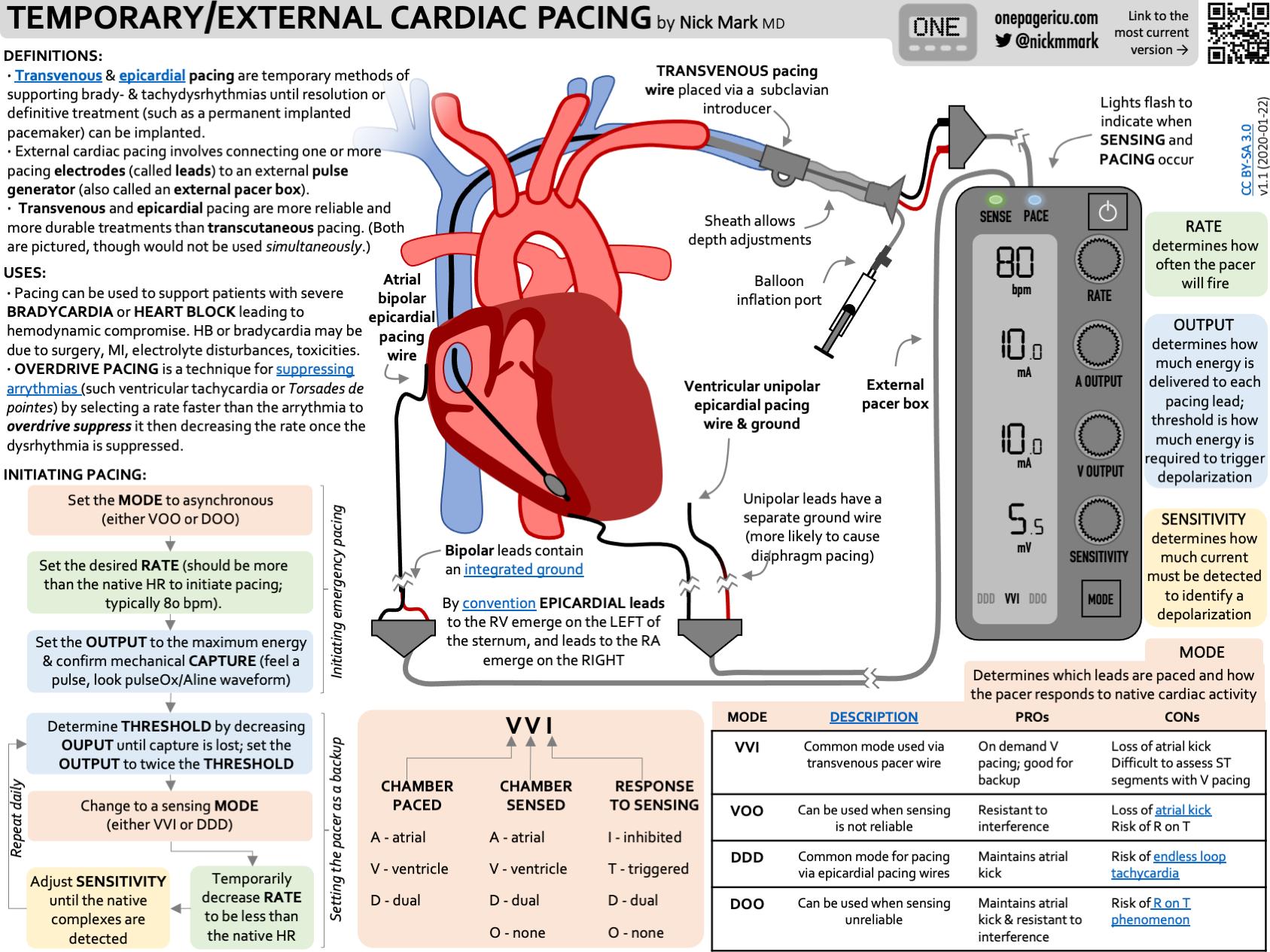
Pacemakers

Before I became an NP, I worked for a lot of years as a nurse in a cardiac surgical ICU. So, I became pretty acquainted with external pacemakers. Essentially, all the heart surgery patients came out with epicardial pacing wires attached to an external pacemaker. Because the CTICU I was working in was also the CCU, I got a fair amount of experience with transvenous pacemakers as well. But, unless you’ve worked in those specialized environments (and really just due to the volume, the CTICU is the place you really get to know these devices), you probably have a limited exposure to external pacing. At least outside of the transcutaneous pacing learned in ACLS.

Two great resources for you today on this topic (well, more really because one of these has some other really good links in it as well). Scott Weingart over at EMCrit just did a really great episode of his podcast dealing with transvenous pacemakers. He covers insertion – which is a really pretty specialized skill, but one that you should have if you practice in a setting where cardiology isn’t always readily available – as well as the box itself and some troubleshooting. The same principles (other than insertion, of course) apply to epicardial pacing if you should find yourself in a CTICU and need some help with this complex topic. He covers modes and sensitivity as well. He does a good job of explaining sensitivity, which is probably the most confusing part of pacemakers. The wall analogy that he uses is pretty similar to the “see over the fence” analogy that I use when I teach this concept, so I won’t belabor it here. He also mentions a great talk that Dr Sarah Wesley gives on the subject at the Bedside Critical Care conference. He links to it in his post, or you can go directly there.

Finally, a great new site that I just discovered, ICU One Pager, has a phenomenal resource on emergency pacing that covers everything you need to know on one page. Shown below, or you can download it as a PDF from their site.

Hampton’s Hump

We all know that CTA is the way to diagnose PE in a patient, but this requires a trip to CT and a large dose of IV contrast. So, there are ways to narrow things down in patients for whom PE is suspected. Most of us are familiar with evaluating right heart strain on bedside echo, and lots of us know that you can identify certain characteristic ECG changes. But, somewhat less well known is the radiographic sign known as Hampton’s Hump. This is a dome-shaped opacification that is most commonly associated with PE, but also can be a sign of pulmonary infarction due to other causes, such as angioinvasive aspergillosis. PE causes a wedge shaped infarct with sparing of the apex due to collateral circulation in the bronchial arteries. This leads to the characteristic rounded shape.

New England Journal of Medicine’s Images in Clinical Medicine series recently featured a nice example of this. This requires a free NEJM Online account to view the entire post (but the free account is well worth your time).

Impella

The Impella is a percutaneous left ventricular assist device (LVAD). Think of it as an IABP (Intra-Aortic Balloon Pump) on steroids. That’s not entirely accurate because it doesn’t augment coronary perfusion like the IABP does, but it’s close. It does unload the LV and assist the pumping of a failing heart. It can be inserted fairly quickly, either through the femoral or axillary artery and can be done in the cath lab or even at the bedside in some cases.

It comes in several sizes, with larger ones generating more flow. In addition to being used one it’s own, it’s nice when used in combination with peripheral VA ECMO. When inserted peripherally, VA ECMO generates retrograde flow through the aorta (the cannula is inserted into either the femoral artery or subclavian artery so blood flows through the aorta towards the heart) which can make a failing left ventricle fail even faster. An Impella can be inserted to offload the LV, somewhat counters the effects of the retrograde ECMO flow.

Count Backwards From 10 does a nice little review with illustrations.

Push Dose Pressors

You’re intubating a patient who is hemodynamically tenuous, or worse, was hemodynamically stable prior to induction. After administration of the sedative they become hypotensive. In many cases, the hypotension doesn’t present immediately because of the sympathetic stimulation of the laryngoscope. But once the tube is in and things settle down, the BP starts to drop. What do you do? This is almost always a transient problem. Do you need to start a drip? Anesthesiologists and an increasing number of EM providers use something called “push dose pressors.” Little boluses of vasopressor agents that can bolster your patient’s blood pressure to get them through a transient drop. In this article on Critical Care Now, Ruben Santiago covers the Pearls and Pitfalls with Push Dose Pressors. Although he approaches this from a ED perspective, the concepts are the same for transient hypotension associated with sedation in the ICU.

Propofol and Hypotension

Propofol is a super common medication that we use for induction prior to intubation and for maintenance of sedation in the ICU. One of the big downsides of its use is the risk of hypotension. In this episode of the Elective Rotation podcast, Pharmacy Joe addresses the question “Can hypotension from propofol be predicted?” Although we can and do often use push-dose pressors to deal with this temporary hypotension from propofol and other similar agents in RSI scenarios, there are other situations where adequate sedation with propofol can lead to hypotension. In these situations, are the only answers to switch sedatives, tolerate inadequate sedation, or start vasopressor infusions? Nope. Give this episode a listen to discover more about predicting who will become hypotensive and how to prevent it (in some cases). Listen here.