Barium Swallow

This is a test we order a LOT in the NSICU. It’s used to ensure that patients who have had a brain injury and an equivocal bedside swallowing exam are actually safe to swallow. They’re used a lot with another group of patients I see in the SICU a lot too, esophagectomy patients. In that case, it’s less to make sure patients aren’t aspirating and more to make sure their esophageal anastomosis isn’t leaking before they’re allowed to resume eating.

But, we often don’t see the images, just the report. So, this Instagram post from theradiologistpage is really interesting. You can see the anatomy and functional assessment involved in this study. For our Speech Language Pathologist (SLP) colleagues, this is a test they use all the time to help us determine if it’s safe for our patients to eat and what consistency/thickness of liquids are safe.

Intra-Aortic Balloon Pump

Although there are newer devices out there to augment cardiac function and serve as temporary ventricular assist devices, the mainstay device is still the Intra-Aortic Balloon Pump (IABP). It’s a relatively straightforward system using a balloon inflating and deflating in the aorta in time with the cardiac cycle and it offers both unloading of the LV and enhancement of coronary perfusion. Over the years, the technology of these devices has improved dramatically. When I was a CVICU nurse back in the day, we used to have to constantly adjust the timing on the pumps to maximize the effectiveness. Nowadays, the computer processing is so good, in my experience, it’s really hard to improve on the timing. But, it’s still good to know how, and how to troubleshoot the device.

This Twitter thread from Matt DiMeglio (@Matt_DiMeglio) does a great job of reviewing how the IABP works, the physiology behind Intra-Aortic Balloon Counterpulsation (why the IABP helps), what the waveforms mean, what the alarms mean, how to troubleshoot, and generally everything you need to know about IABP while on your Cardiac ICU rotation. These devices will be found in CCUs as well as CVICUs, and I’ve even used them in the NSICU! This is a great thread to read and bookmark for the next time you find yourself dealing with the balloon pump.

Axis Deviation

So, I’m on a roll with student-inspired posts. This is something we covered in class recently when talking about interpretation of 12-lead ECGs, the concept of axis deviation. An Instagram Account that I just discovered called Master Your Medics has a nice post on understanding what axis deviation is. I think this can be confusing if you’re just learning to read 12-lead ECGs. You may never have even heard the term “cardiac axis” much less “axis deviation” before. So, what is it and why does it matter?

That’s pretty basic, but that really does boil it down simply. How do you determine what your axis is on a 12-lead? That’s a little more involved, but there are some really simple techniques. I could go into a lengthy discussion here, but why reinvent the wheel? As usual, our friends over at LITFL have us covered! Mike Cadogan and Rob Buttner do a great job of explaining the cardiac axis and how to determine it for yourself (without relying on the ECG machine to tell you).

How to Read a CTA for Pulmonary Embolism

A student of mine emailed me the other day asking if I knew of any good resources for learning to read a CTA of the chest for pulmonary embolism. This is something that I’m not very good at. I try to learn to read my own radiography whenever I can, not to supplant the radiologist, but more because I’m interested in how it’s done. Also, I feel like if I have an idea how to do something myself, it gives me a leg up because I don’t have to sit and wait for the read or at least if I do, I have some idea already what it’s going to say.

I remembered finding a good video once that explained it, so I set to Googling and easily found the video I had remembered watching before. Sarel Gaur is a radiologist who has a really great YouTube channel with videos covering lots of good radiology topics. This particular video covers the basics of reading a CTA for PE. There is a follow-up video here that does a case walk through.

iScan 2022

This post isn’t so much educational or to promote some great #FOAMed educational resources, but is to promote an educational event. I’m going to be an instructor at a POCUS event coming up in May called iScan 2022. This is put on by the Society of Point of Care Ultrasound (SPOCUS) and is a POCUS “competition” aimed at PA and NP students. Why is competition in quotes? Well, because it’s really a teaching event disguised as a contest. It’s a great idea to gamify this sort of education. Students register in teams (solo students will be grouped together into teams or added to existing teams) and will go around to various stations where there will be teaching and contests. But it’s all in fun! And it’s FREE!! (Free POCUS training is like a unicorn!)

This is the 5th year, but the first year I’ll be a part of it and I’m super excited! (I was supposed to do it last year, but couldn’t go due to COVID). It’s May 23rd in Indianapolis, IN. If you’re a PA student, that coincides with the AAPA conference, so you may be in town anyway, why not come learn some POCUS? For information, including a link for registration, can be found here.

NPs, the website is heavy on the PA language, but it’s just as much for you! Historically, it’s pretty PA heavy because of its association with the AAPA conference. But, SPOCUS is specifically interested in growing support among NP students. At least a few of the instructors will be NPs and there will be teams of NPs. So, come represent!

Low-Concentration Peripheral Norepinephrine

We’ve talked before about norepinephrine as a powerful and commonly used vasopressor in the ICU. This is often my go-to pressor for all types of shock, unless it’s cardiogenic shock or I’ve got reason to suspect that contractility is part of the problem. But, historically it has to be infused through a central venous catheter because of the potential risks of infiltration.

It used to be my practice to use phenylephrine when I needed a little bit of vasopressor but wanted to avoid a central line or the need for pressors was too urgent to wait for central line placement. This might be in the face of rapidly progressing, life-threatening shock when even the few minutes it would take to place a central line would be an unacceptable delay in pressor administration. Or, maybe the patient just needs a time-limited run of pressors, while recovering from anesthesia/procedural sedation, for example.

But, while phenylephrine is generally thought of as safe for peripheral administration, it’s really not the optimal vasopressor. I do use push doses of phenylephrine for transient hypotension associated with endotracheal intubation, for example. But, a phenylephrine drip is almost never what I want. If my patient needs a drip, they probably need norepinephrine.

In this episode of the Elective Rotation, Pharmacy Joe discusses the safety and efficacy of using low-concentration norepinephrine through peripheral venous access. Low-concentration norepinephrine has decreased risks in cases of infiltration as compared to standard-dose. Additionally, Tyler Jones has a great post over at Critical Care now discussing more broad use of peripheral vasopressors.

Either way, I think if a patient is sick enough to require norepinephrine at higher doses and/or longer periods of time, the risk of peripheral administration outweighs the risks associated with central venous access. So, put in the central line.

Ultrasound Case: PE

Bedside echo can be very helpful in the diagnosis of pulmonary embolism. There are a number of things to look for including septal bowing, right-heart strain in the form of increased RV size and decreased RV function, McConnell’s sign, and the always exciting clot in transit. Sarah Wolochatiuk is a PGY-4 in Emergency Medicine at the University of Cincinnati just up the road from me. She has a great case presentation on the UC EM blog Taming of the SRU that covers all of this with some great echo images as well.

Working From Home

A lot of people are now working from home quite a bit due to the pandemic. It can be great at times (you can wear your pajamas! But, I guess most of us wear pajamas (aka scrubs) to work every day…) but there are definite challenges as well. I’m not great at it, but I’m getting better. For me, the biggest challenge are those days when the rest of my family is home as well. Jennifer Kanapicki Comer, MD wrote a really great piece for the Academic Life in Emergency Medicine (ALiEM) blog recently called The 1440 Doctor: How to Unplug While Working From Home. She discusses the challenges of working from home and how to deal with them (who knew that the lack of a commute could be a problem?). I’m trying to implement a lot of them (including implementing the WFH Commute) on days when I’m at home working on fellowship stuff, or teaching stuff, or this blog for example. Check it out, I think you’ll find it helpful!

Enteral Nutrition

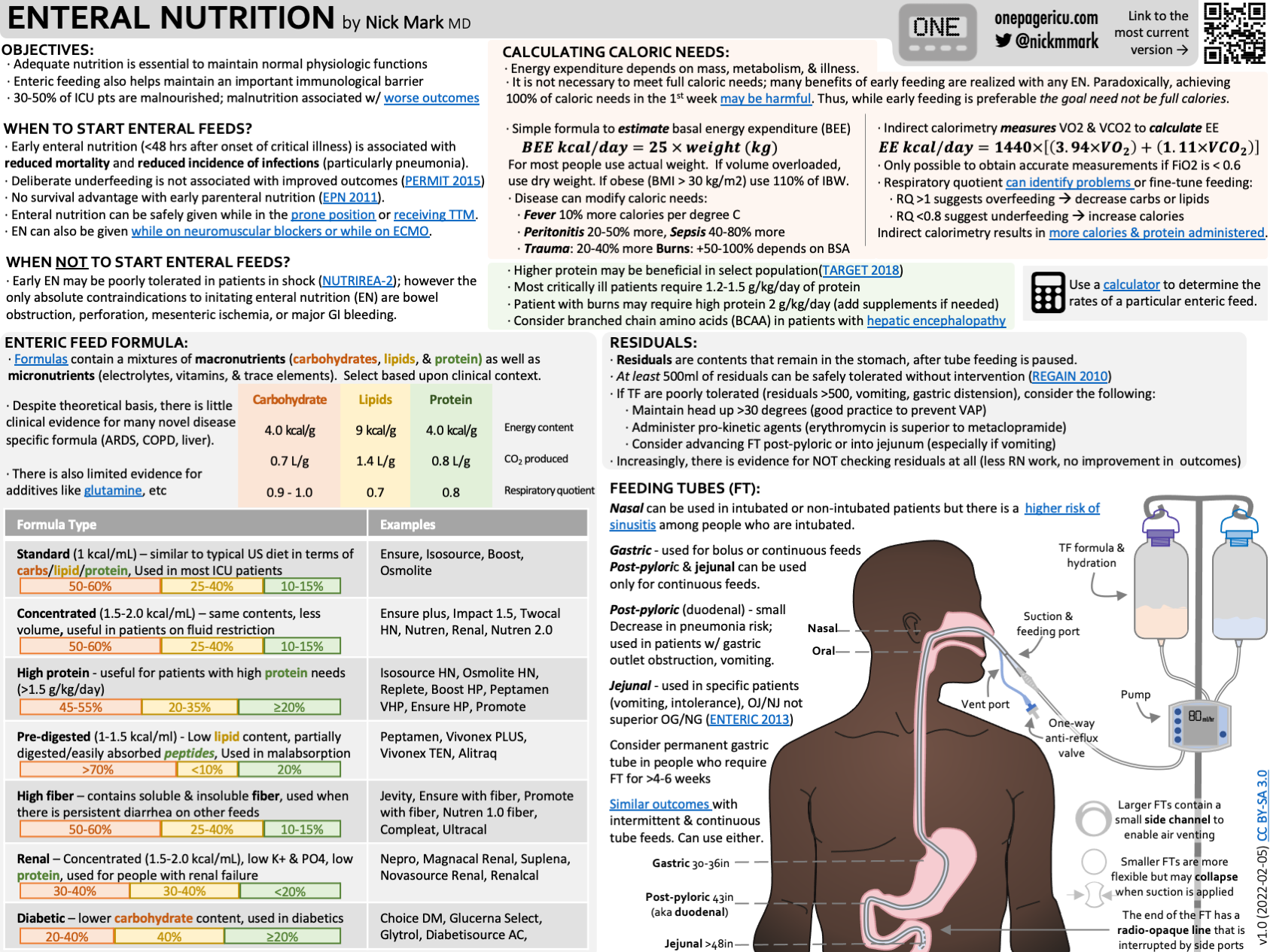
In medicine generally, and critical care specifically, we’re not always so great about nutrition. After all, that’s why we have dietitians, right? Well, I’ll be the first to say that Registered Dieticians (RD) are invaluable members of the ICU team, and I rely on their expertise daily. However, they’re not always available. Additionally, as ICU providers, we should all be at least somewhat familiar with the basics of nutrition. So, when should we start enteral nutrition? When should we not? OK, we’re going to start tube feeding, which formula? How much?

As usual, Nick Mark over at onepagericu.com has you covered. This great ICU One Pager (PDF or PPT) on Enteral Nutrition covers everything you, as an ICU provider, need to know. This will at least help you get started until you can consult your local RD, or help you to provide proper nutritional therapy for your patients if you don’t have an RD available.

Keeping Up with the “Literature,” Part 4

When I started this series of posts, I really thought it would be one additional post sharing some of my process, but it’s turned out to be a lot longer. I think that this will be the last one in the series (for now at least) and we’ll cover some practical tips for my 2 favorite resources, blogs and podcasts.

Blogs

There are a ton of great blogs out there and I follow a bunch of them. Social media has the advantage of offering “quick bites” that can be scanned in a hurry and podcasts offer the ability to get educational content while doing other things (multi-tasking is always helpful in this busy world). But, blogs offer the distinct advantage of long-form, written content. Blogs can offer the space to really flesh out thoughts, link to other resources (including the original journal articles), and the ability to re-read passages for greater understanding.

The 2 biggest downsides for blogs are the length of time required to read posts and keeping track of all the content out there. The best tool I have found for dealing with both of these issues is an RSS reader. RSS readers allow you to subscribe to blogs and have content automatically delivered to you as soon as it’s released. There are a number of great options out there, I use one called Newsblur. I have it as an app on my phone, but it is also available as a website and tablet app. It’s simple and straightforward and free (my 2 big requirements). I can create categories for different blogs and then there are some categories that I review daily, some weekly, and some monthly. If I come across a post that interests me but I don’t have time to read it now, I can save it for later. I typically check this app daily and at least sort through what’s new and deciding if it’s something I’m interested in or not.

Podcasts

So, podcasts are far and away my favorite way to download (no pun intended) new info in terms of research and education. My favorite thing about podcasts is that they allow for multi-tasking. As I mentioned in an earlier post, I listen to podcasts while I mow my yard, while I walk my dog, and driving to and from work. This is a great time saver for me.

As far as organization, I just use the default Apple Podcasts app on my iPhone. I know that there are other options out there and have tried a few. But I keep coming back to Apple Podcasts. It’s simple and easy and free. The only thing I don’t love is that there is not a great way to organize podcasts. I’d like a way to categorize these, especially separating medical podcasts from those I listen to just for personal interests.

The last big trick I’ve started using with podcasts is adjusting the speed. This is something I had initially resisted because it felt weird. But, you get used to it and it becomes a helpful time saver. I typically listen to podcasts for fun at normal speed. If it’s a topic that I’m familiar with, I’ll listen at 1 1/2 x speed, sometimes rewinding and slowing down if I need to spend a little more intense concentration on a particular part. Sometimes I’ll listen to an episode at 2x speed if it’s a topic I know well and I just want to hear a particular take to see if I can recommend it to readers or students (but 2x does get sort of hard to listen to and understand if it’s at all complex). I’ll sometimes listen to Spanish podcasts at 1/2x speed to practice my Spanish skills.

Hopefully, this series has been helpful to you in terms of offering some more tools to keep up with the constant stream of critical care literature and education out there!